
China High-Speed Rail: A Complete Guide for Foreign Travelers
Foreign passports can book directly online and pass gates without paper tickets. Everything about booking, stations, seat classes, luggage and fares.
With more than 45,000 route-kilometers reaching over 90% of cities above a million people, China's high-speed network is not just fast — for foreign visitors it is arguably the most user-friendly intercity system anywhere: foreign passports book directly online, gates read passports, and paper tickets no longer exist. This guide walks through booking, stations, classes, luggage and the mistakes first-timers make.
Decoding the Train Codes
| Code | Meaning | Typical speed | Best for |
|---|---|---|---|
| G | High-speed service | 300-350 km/h | Long trunk routes: Beijing-Shanghai, Beijing-Xi'an |
| D | Conventional EMU | 200-250 km/h | Shorter or G-less corridors; lower fares |
| C | Intercity | Varies | Neighboring-city hops: Beijing-Tianjin, Guangzhou-Shenzhen |
Where G and D both run the same corridor, the trade is time against money; for long distances default to G.
Three Ways to Book
| Channel | Price | Character | Best for |
|---|---|---|---|
| 12306 official site/app | Face value, zero fees | Direct sale; foreign passport registration supported; English interface available | Anyone willing to spend 10 minutes registering |
| Trip.com and similar OTAs | Face value + small service fee | English-first, friendly payment, clear refunds | Visitors who value convenience |
| Station counters/machines | Face value | The fallback; queues at peak times | Same-day changes and emergencies |
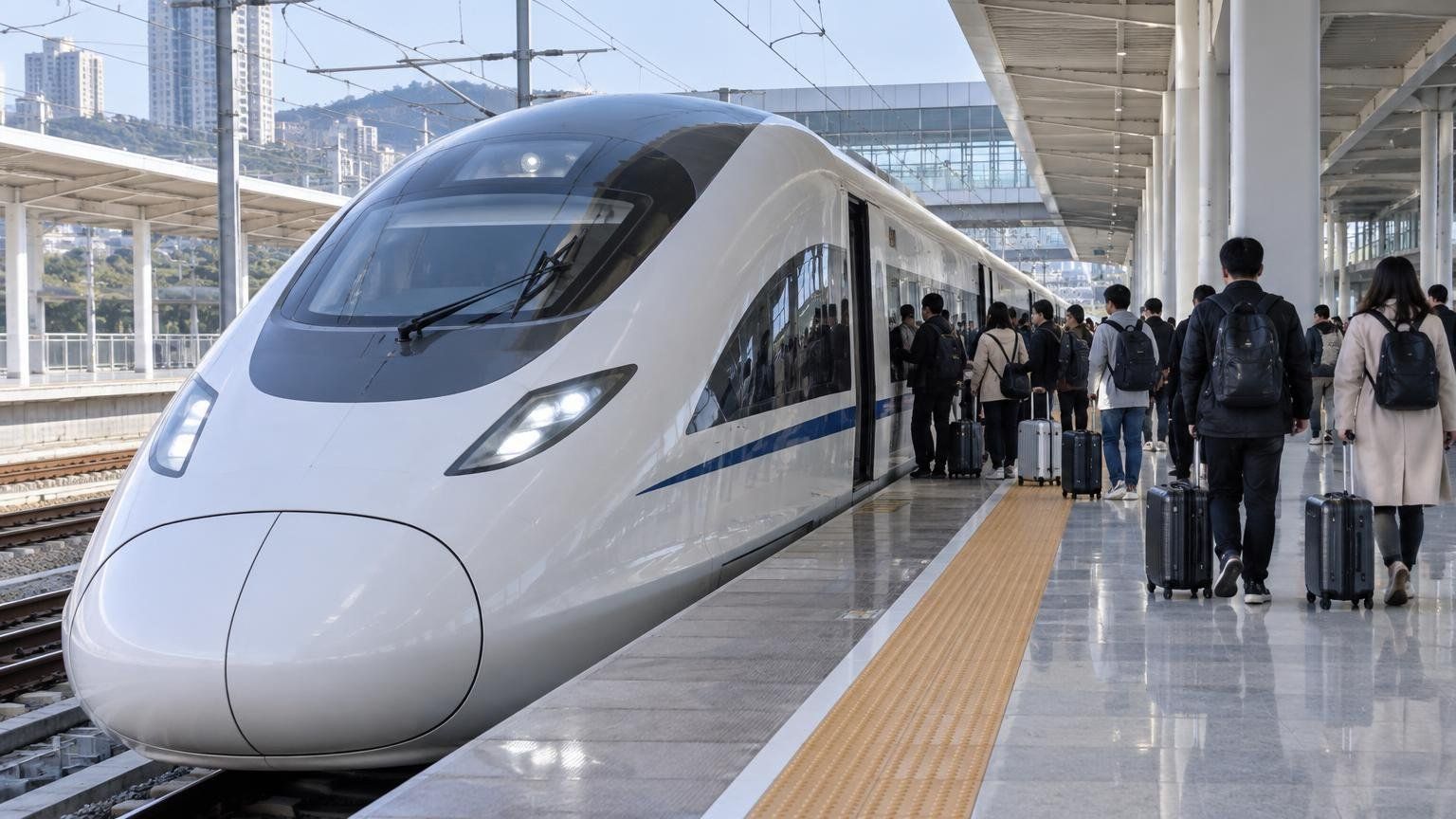
From Door to Seat: The Full Sequence
- Arrive 40-60 minutes early: the big hubs — Beijing South, Shanghai Hongqiao, Xi'an North — are airport-scale; security plus the walk to your gate easily eats 20 minutes
- Security: person and bag screening, stricter than the metro; power banks and lighters are quantity-capped, blades prohibited
- ID check: foreign travelers use the staffed lane with passports (major stations now have passport-reading gates). Your passport is the ticket — nothing to collect
- Find your gate on the boards: departure halls list every train with its check-in gate, which opens about 15 minutes before departure
- Board: match your car number to the platform markings and take your assigned seat
Choosing a Class
- Second class: 3+2 layout, the value pick — perfectly fine up to about four hours
- First class: 2+2, deeper recline, quieter car; worth it beyond four hours
- Business class: 1+2 seats that lie flat, snacks included, at roughly 3.5× second class; sensible for red-eye connections or expense accounts
- Seating notes: A and F are window seats; if you are carrying large luggage, sit near the car ends by the racks
Popular Routes: Times and Fares
| Route | Duration | 2nd class | 1st class |
|---|---|---|---|
| Beijing South → Shanghai Hongqiao | 4.5-6 h | ≈ ¥560-660 | ≈ ¥930-1,060 |
| Beijing West → Xi'an North | 4.5-6 h | ≈ ¥515-560 | ≈ ¥820-900 |
| Shanghai Hongqiao → Hangzhou East | 45-60 min | ≈ ¥73-87 | ≈ ¥120-140 |
| Shanghai Hongqiao → Nanjing South | 1-1.5 h | ≈ ¥120-140 | ≈ ¥200-230 |
| Chengdu East → Chongqing North | 1-1.5 h | ≈ ¥150 | ≈ ¥240 |
| Guangzhou South → Shenzhen North | 30-40 min | ≈ ¥74-100 | ≈ ¥120-160 |
Most trunk lines now use floating fares: identical routes vary 20-30% by train and date, so treat 12306's live price as the truth. Early-morning, late-evening and slower trains are the cheap end.
Luggage and Onboard Life
- No strict weight limits, but everything goes through the X-ray; 28-inch cases fit the racks at car ends — board early at busy times to claim space
- Hot water dispensers at car ends (the spiritual home of instant noodles); dining car or QR-code ordering covers meals, and bringing your own food is entirely normal
- Smoking, including e-cigarettes, is prohibited anywhere on board — alarms trigger emergency braking
- Outlets at seat level use Chinese two-pin plus USB; carry an adapter
Frequently Asked Questions
What if I miss my train?
One free same-day change is allowed (fare difference may apply); after departure you can only rebook onto another train that same day. Refund fees are tiered: free beyond 8 days, 5% from 48 hours to 8 days, 10% within 24-48 hours, 20% inside 24 hours.
Train or plane?
On corridors of four to five hours or less — Beijing-Shanghai, Beijing-Xi'an, Shanghai-Shenzhen — rail usually wins door-to-door once airport transfers and check-in are counted, with far better punctuality. Beyond six hours (Beijing-Guangzhou is eight), a discounted flight wins.
How do children's tickets work?
Under 6 and not occupying a seat: free with an adult. Ages 6-14: discounted child fare. 14 and up: full fare. Details follow 12306's current rules.
Send us your city list and we will build the timetable for you — threading connections across multiple cities is its own craft, and it is one we practice daily.
Need help planning your China trip?
Contact our travel advisors for personalized route suggestions.