
China's 240-Hour Visa-Free Transit: The Complete Guide
How China's 240-hour visa-free transit works: eligible countries, the three hard conditions, entry process, common pitfalls, and a tested 10-day route.
Visa rules can change after an article is published. Check the dated information below against the latest official notices for your passport and departure date before booking.
National Immigration Administration: latest noticesMinistry of Foreign Affairs: consular noticesIf your flight connects through China, you may be able to skip the visa entirely and spend up to 10 days (240 hours) in the country. The policy, fully upgraded in December 2024, unified the old 72/144-hour schemes into a single 240-hour window — the lowest-cost way for most travelers to turn a layover into a real visit. This guide covers eligibility, the entry process and the mistakes that catch people out. Policy details are ultimately governed by the National Immigration Administration's latest announcements.
Policy at a Glance
| Item | Detail |
|---|---|
| Stay | 240 hours (10 days), counted from 00:00 the day after entry |
| Eligible countries | 54 (mostly Europe, plus US, Canada, Australia, New Zealand, Russia, Japan, Korea and more) |
| Advance visa application | None — granted at the border |
| Core requirement | Valid travel document + confirmed onward ticket to a third country |
| Ports of entry | 60 designated ports (major international airports and selected land crossings) |
| Permitted area | Designated provinces and municipalities, with several cross-province zones |
Who Should Use 240-Hour Transit
- Travelers whose nationality is not on the 30-day unilateral visa-free list — most notably US citizens, who do not currently qualify for 30-day entry but fully qualify for 240-hour transit
- Multi-country itineraries: Europe → China → Japan, or North America → China → Southeast Asia — a 5-10 day stopover slots in perfectly
- Short business visits: exhibitions, factory inspections and meetings usually fit inside ten days
Conversely, if your nationality is already on the 30-day visa-free list (most of Europe, Japan, Korea, Singapore, Australia, New Zealand, much of South America — the UK and Canada joined in November 2025), go straight for 30-day entry: no third-country ticket constraint at all. The comparison table below helps you choose.
Three Conditions, All Mandatory
- A valid travel document: passports should carry at least six months' validity and spare blank pages
- A confirmed onward ticket to a third country (or region) within 240 hours. The destination cannot be your country of departure: US → China → US round trips do not qualify, but US → China → Japan → US does
- Entry via a designated port, staying within the permitted area: your arrival port must be one of the 60 designated ports, and your itinerary must stay inside the approved provinces. Major zones — Beijing-Tianjin-Hebei, Shanghai-Jiangsu-Zhejiang, the Greater Bay Area — are linked for cross-province travel; verify the current scope before designing a route
The Entry Process in Five Steps
- At check-in: tell the airline agent you are using visa-free transit and show your passport and onward itinerary (print an English copy — some counters insist on paper)
- On the plane: complete the arrival card handed out by the crew
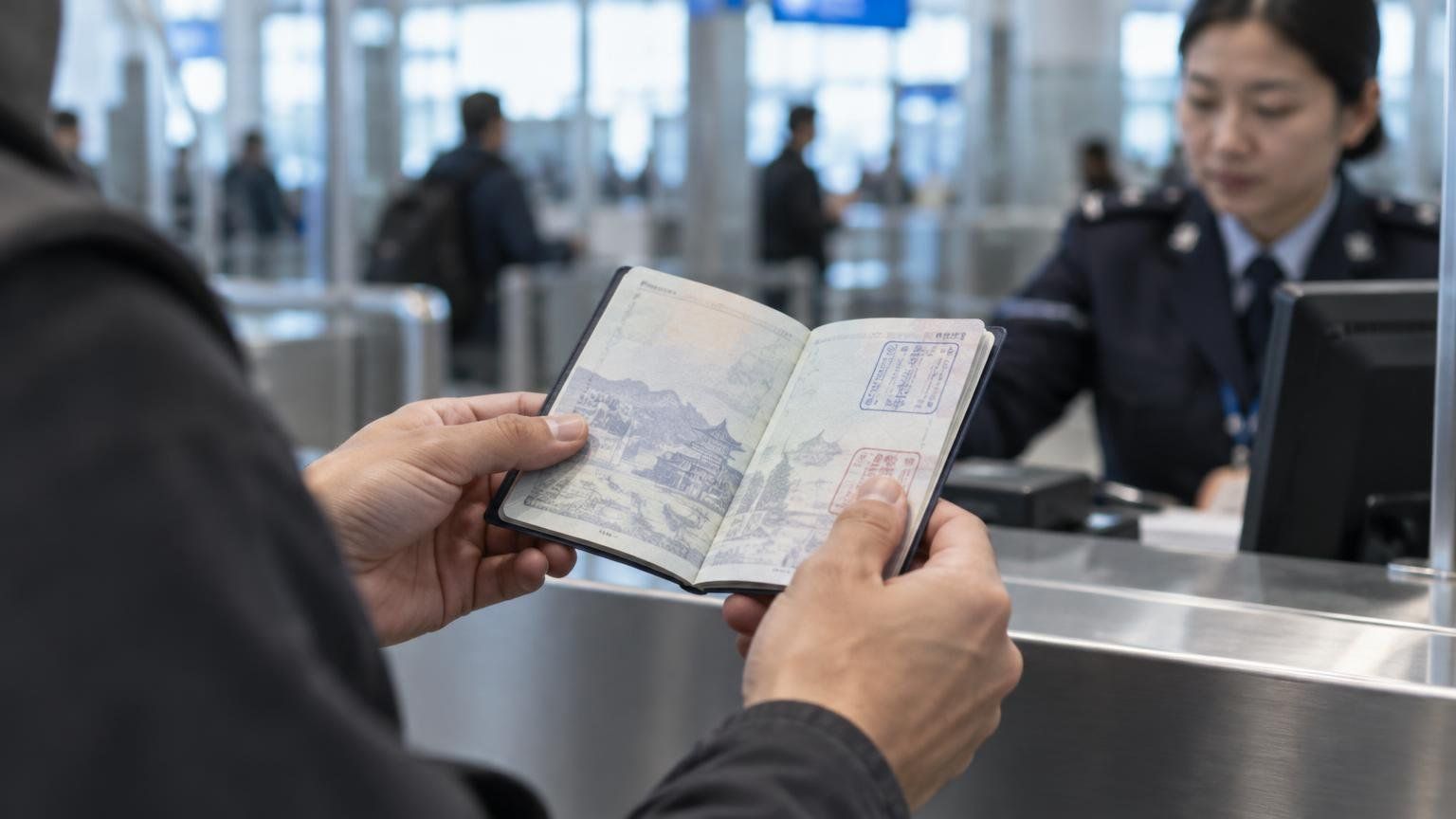
- At immigration: use the Foreigner lane and present passport, arrival card and onward ticket; state your transit plan briefly. The officer stamps a temporary entry permit noting your allowed stay
- Collect bags and enter: from here you move around like any other visitor
- On departure: leave via a designated port within your permitted window on that third-bound flight
240-Hour Transit vs 30-Day Visa-Free
| Feature | 30-Day Visa-Free | 240-Hour Transit |
|---|---|---|
| Stay | 30 days | 10 days |
| Third-country ticket | Not required | Mandatory |
| Countries | 48 (US not included) | 54 (US included) |
| Ports | All open ports | 60 designated ports |
| Permitted area | Mainland-wide (restricted zones aside) | Designated provinces |
| Best for | Direct trips to China | Stopovers and short stays |
The Four Pitfalls We See Most
- No printed itinerary: border officers may ask for paper proof of onward travel; phone screenshots are sometimes refused. Print two copies — one checked in, one carried
- Treating your origin as the third country: A → China → A fails; the post-China leg must reach a third country (routing onward via Hong Kong, Macau or Taiwan is common, though final interpretation rests with border control)
- Straying outside the permitted area: an over-ambitious route crossing into non-approved provinces creates problems at departure. Keep cities within one linked zone
- Cutting the 240 hours too fine: the clock starts at 00:00 the day after entry. Build in buffer for flight delays — leave on day 9, not day 10 at the wire
What 10 Days Buys You: A Proven Route
240 hours is exactly enough for the golden triangle: Beijing 3 → Xi'an 2 → Shanghai and surroundings 3, plus arrival and departure margins. All three sit on the trunk rail network (Beijing-Tianjin-Hebei and Shanghai-Jiangsu-Zhejiang are linked zones; confirm the Henan transit scope when booking), with legs of 4.5-6 hours at a relaxed pace.
Prefer depth over breadth? Stay inside one region: ten days of Beijing-Tianjin-Hebei (Beijing, Chengde, Tianjin), or Shanghai-Jiangsu-Zhejiang (Shanghai, Suzhou, Hangzhou, Huangshan). Smaller footprint, lower policy risk, richer experience.
Frequently Asked Questions
Can I use it more than once?
Yes — the policy sets no lifetime cap, and each entry is assessed independently. Chained routings like China → Japan → China are legitimate as long as every entry satisfies the third-country ticket condition.
Can the 240 hours be extended?
No. The limit is hard and departure is mandatory when it expires. Longer stays need an L tourist visa arranged in advance at a consulate.
What will they ask me at the border?
Purpose, length of stay and your onward flight — short, factual answers. Occasionally you will be asked to show a hotel booking. Nervousness causes more problems than the questions do; this is a mature, high-volume program and officers have seen millions of transit visitors.
Designing a stopover? Send us your flight plan and wish list — we will verify the policy fit and build a route you can actually finish inside ten days.
Need help planning your China trip?
Contact our travel advisors for personalized route suggestions.